TL;DR
Check the report and the sample separately. Verify the certificate through the issuing laboratory, then check the documentation connecting the tested sample to your product or batch. A genuine report does not automatically establish that connection. Peptide Test Canada verification portal (report-specific authentication not completed) ↗
Identity, purity, and quantity answer different questions. In the supplied retatrutide example, the report states 99.3% chromatographic purity and 23.38 mg net peptide content against a 20.00 mg target. None of those numbers should substitute for another. Peptide Test Canada verification portal (report-specific authentication not completed) ↗
Read the limits, not just PASS. This certificate covers the submitted sample and the tests described; it does not establish sterility, absence of endotoxins, or suitability for human or veterinary use. Peptide Test Canada verification portal (report-specific authentication not completed) ↗
What a COA does—and does not—tell you
A certificate of analysis, or COA, documents analytical results for an identified sample or material. Reading one well means separating the questions each test answers instead of treating every number as a general quality score. Bachem, Quality Control of Amino Acids & Peptides ↗
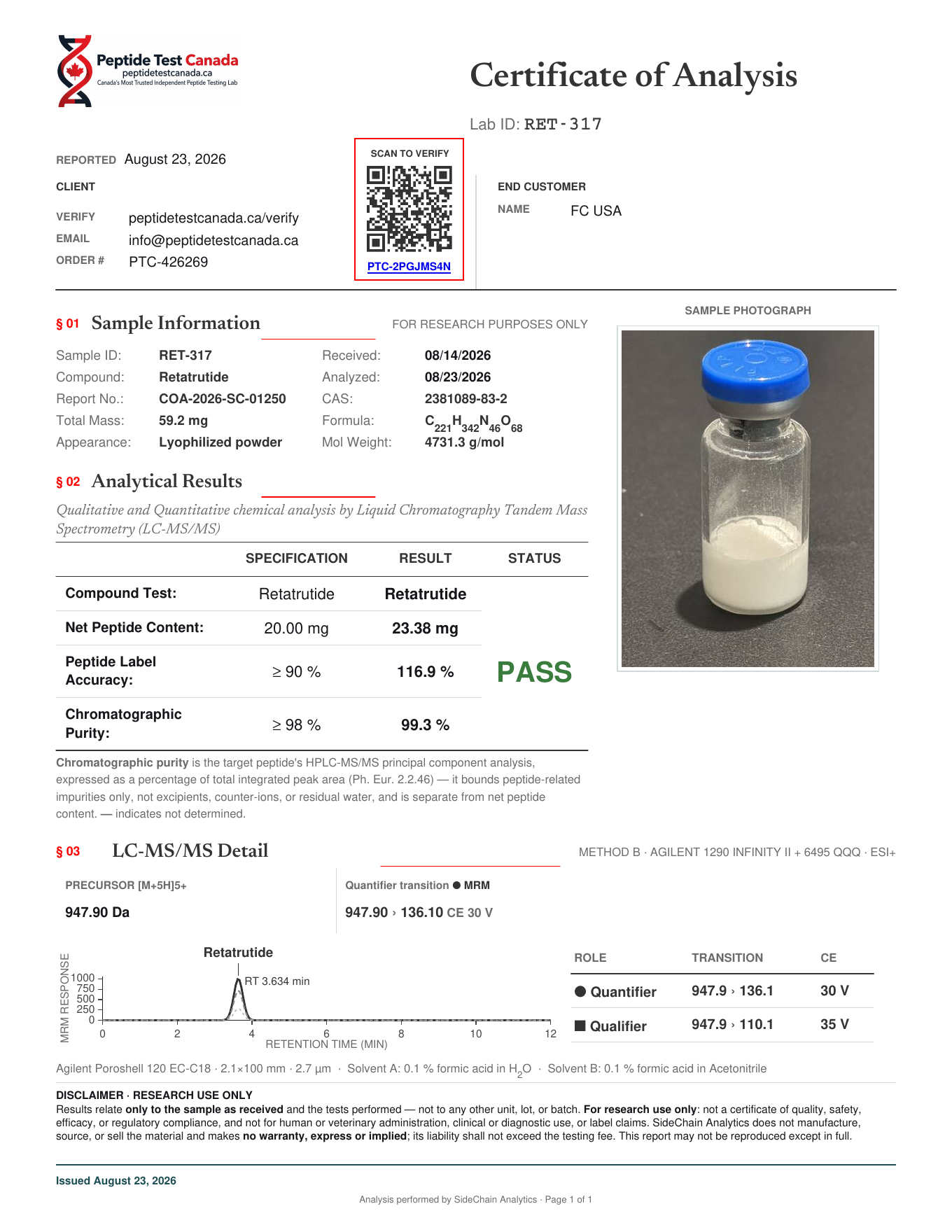
This guide uses retatrutide report COA-2026-SC-01250, sample RET-317, as a worked example. The supplied document carries Peptide Test Canada branding and states that SideChain Analytics performed the analysis. We interpret the document as written; this is not an independent authentication or re-test. Peptide Test Canada verification portal (report-specific authentication not completed) ↗
1. Start with the sample, not the purity percentage
In § 01 Sample Information, the certificate identifies Retatrutide, sample RET-317, and report COA-2026-SC-01250. It records receipt on 14 August 2026 and analysis on 23 August 2026, with verification code PTC-2PGJMS4N. Peptide Test Canada verification portal (report-specific authentication not completed) ↗
Keep these identifiers separate. A report number identifies a document; a sample ID identifies what the laboratory received. Neither is automatically a manufacturing batch number. Here, RET-317 is labelled as a lab/sample ID, not a batch number. Peptide Test Canada verification portal (report-specific authentication not completed) ↗
For a product-to-report check, look for a documented connection between the vial's lot or batch and the submitted sample. This example names FC USA as the end customer, not Ember Peptides. That difference does not establish fraud, but the PDF alone does not explain the relationship. Ask for the connection rather than assume it. Peptide Test Canada verification portal (report-specific authentication not completed) ↗
2. How to verify peptide lab results
Verification has two parts: did the laboratory issue this report, and does it apply to the material you are checking? The second question remains important even when the first is answered. Peptide Test Canada verification portal (report-specific authentication not completed) ↗
Start on the laboratory's own website and use its verification facility rather than treating a vendor-hosted PDF or QR code as sufficient proof. For this example, the certificate displays the code PTC-2PGJMS4N for the Peptide Test Canada portal. Peptide Test Canada verification portal (report-specific authentication not completed) ↗
Compare any returned record with the PDF: compound, sample and report identifiers, dates, and numerical results. If anything differs, ask the laboratory whether an amended report explains the difference before drawing a conclusion. Peptide Test Canada verification portal (report-specific authentication not completed) ↗
A matching laboratory record still does not establish who selected the sample or whether it represents other vials. The certificate limits its findings to the sample received. A failed lookup is a reason to recheck the code and contact the issuer using independently obtained details—not, by itself, proof of a fake certificate. Peptide Test Canada verification portal (report-specific authentication not completed) ↗
3. Read the analytical results across each row
In § 02 Analytical Results, the specification is the stated target or acceptance criterion, while the result is the laboratory's reported finding. The report describes liquid chromatography–tandem mass spectrometry (LC-MS/MS) and lists Compound Test, Net Peptide Content, Peptide Label Accuracy, and Chromatographic Purity. Peptide Test Canada verification portal (report-specific authentication not completed) ↗
The rows report Retatrutide for the compound test; 20.00 mg specified and 23.38 mg reported for net peptide content; at least 90% specified and 116.9% reported for label accuracy; and at least 98% specified and 99.3% reported for chromatographic purity. Peptide Test Canada verification portal (report-specific authentication not completed) ↗
The label-accuracy calculation from the printed figures is 23.38 mg ÷ 20.00 mg × 100 = 116.9%. That is 16.9% above the stated target amount; it is not 116.9% purity or a confidence score. Peptide Test Canada verification portal (report-specific authentication not completed) ↗
The certificate shows PASS, but its printed label-accuracy criterion is only ≥ 90%; it does not print an upper limit. Do not silently replace the stated criterion with a range such as 90–110%, or interpret more than the target as automatically better. Read PASS against the actual criteria. Peptide Test Canada verification portal (report-specific authentication not completed) ↗
4. HPLC purity versus net peptide content
Chromatographic purity is not the percentage of the vial's total weight that is peptide. For a typical area-normalised HPLC purity result, the calculation compares the main peptide peak's area with the included peak area; water, counter-ions, and other non-peptide components require different measurements. Bachem, Quality Control of Amino Acids & Peptides ↗
The example's footnote makes its scope explicit: 99.3% concerns peptide-related impurities, not excipients, counter-ions, or residual water. It is separate from the reported 23.38 mg net peptide content. Peptide Test Canada verification portal (report-specific authentication not completed) ↗
The 59.2 mg total mass in § 01 is another distinct entry. The report does not itemise the difference between that figure and the peptide-content result. You cannot identify a particular filler, call the entire difference an impurity, or calculate peptide content by multiplying 59.2 mg by 99.3%. Peptide Test Canada verification portal (report-specific authentication not completed) ↗
Check the units and the laboratory's definition. Some laboratories use net peptide content for a percentage of peptidic material by weight, while this certificate reports Net Peptide Content in milligrams. Similarly named fields are not automatically equivalent. Bachem peptide analysis FAQ ↗
5. How to read an HPLC chromatogram
HPLC, or high-performance liquid chromatography, separates a sample's components before detection. A chromatogram plots detector response over time as material passes through the system. Peak height is not itself a purity percentage. Bachem, Quality Control of Amino Acids & Peptides ↗
Retention time tells you when a peak appears under that method. Comparisons with reference material should use the same chromatographic conditions; a retention time is not a universal fingerprint across laboratories and methods. Bachem, Quality Control of Amino Acids & Peptides ↗
At the bottom of the supplied page, § 03 LC-MS/MS Detail plots MRM response against time. The peak assigned to retatrutide is labelled RT 3.634 min. That is a retention time—not a quantity or purity result. Peptide Test Canada verification portal (report-specific authentication not completed) ↗
MRM, or multiple reaction monitoring, selectively follows chosen precursor-to-fragment ion transitions. One prominent peak in a targeted trace therefore does not establish that nothing else is present, and the displayed trace is not enough to independently recalculate the reported 99.3% purity. Request the chromatographic data and integration details if that calculation matters. Thermo Fisher Scientific, Overview of Mass Spectrometry ↗
6. Peptide mass-spec results explained
Mass spectrometry measures mass-to-charge ratio, written m/z. A charged peptide ion's m/z is not necessarily the same number as the neutral molecule's mass. Thermo Fisher Scientific, Overview of Mass Spectrometry ↗
In this certificate, 947.90 → 136.10 is the listed quantifier transition, while 947.9 → 110.1 is the qualifier. These describe selected precursor and fragment signals. They are not peptide amounts or purity percentages. Peptide Test Canada verification portal (report-specific authentication not completed) ↗
For a molecular-weight check, first establish whether the value is a neutral molecular mass or an ion's m/z. Then compare the same charge state, ion assignment, and mass convention—average and monoisotopic masses are different definitions—and ask for the laboratory's acceptance tolerance. Thermo Fisher Scientific peptide-mapping mass guide ↗
The example lists 4731.3 g/mol as molecular weight and 947.90, labelled [M+5H]5+, as its precursor entry. Charge state explains why the figures differ in scale; it does not establish that this particular assignment is correct. The PDF does not explain their precise reconciliation or give a mass tolerance, so ask the laboratory to clarify rather than assume a match. Peptide Test Canada verification portal (report-specific authentication not completed) ↗
7. COA red flags: what deserves follow-up?
Focus on evidence, not document styling. Ask whether the laboratory's record disagrees with the supplied PDF, whether the laboratory denies issuing it, and whether the supplier can connect the report to the material being checked. Peptide Test Canada verification portal (report-specific authentication not completed) ↗
These questions address different issues: document authenticity, reporting consistency, and sample traceability. A genuine certificate for an unrelated sample is still a traceability problem, even if the PDF itself is authentic. Peptide Test Canada verification portal (report-specific authentication not completed) ↗
Rounded purity numbers, a missing chromatogram, or a different client name do not, on their own, prove fabrication. A missing chart limits what you can inspect; an unexplained batch connection limits what the report supports. Request missing evidence rather than turn either observation into an automatic verdict. Peptide Test Canada verification portal (report-specific authentication not completed) ↗
8. Finish with the tests that are not reported
This certificate shows no sterility, bacterial endotoxin, or heavy-metal results. Those outcomes are therefore not established by this document—not implicitly passed and not implicitly failed. Its disclaimer also excludes conclusions about human or veterinary administration, safety, efficacy, and regulatory compliance. Peptide Test Canada verification portal (report-specific authentication not completed) ↗
If a separate endotoxin report accompanies a COA, read its method, units, result, and acceptance limit independently. EU/mg means endotoxin units per milligram; EU/mL means endotoxin units per millilitre. Neither is a peptide-purity percentage, and an acceptance limit should not be borrowed from an unrelated product. U.S. FDA, Pyrogen and Endotoxins Testing: Questions and Answers ↗
Amino acid analysis can help determine peptide content after breaking a peptide down into amino acids, but it does not provide the intact peptide sequence and answers a different question from an HPLC purity profile. This example reports LC-MS/MS, not amino acid analysis; do not assume an unlisted method was performed. Bachem peptide analysis FAQ ↗
What this example tells you—in one paragraph
The laboratory reports identifying retatrutide in sample RET-317, with 23.38 mg net peptide content against a 20.00 mg target and 99.3% chromatographic purity. It records a pass against its stated criteria. Those findings apply to the submitted sample and described tests; the PDF alone does not establish the connection to an Ember product or batch, independent authentication, or suitability for human use. Peptide Test Canada verification portal (report-specific authentication not completed) ↗
Read a COA as evidence with a defined scope—not as a blanket guarantee. Peptide Test Canada verification portal (report-specific authentication not completed) ↗
Sources and further reading
For analytical-method context, see Bachem's discussion of quality control for amino acids and peptides, including identity, HPLC purity, peptide content, and complementary methods. Bachem, Quality Control of Amino Acids & Peptides ↗
For report-specific lookup, use the issuing laboratory's official verification portal. The supplied report's code is shown above, but this guide does not claim that the particular certificate was successfully authenticated through the portal. Peptide Test Canada verification portal (report-specific authentication not completed) ↗
For mass-spectrometry terminology and endotoxin context, consult the Thermo Fisher and U.S. FDA references linked throughout this guide. Those references explain analytical concepts; they do not approve or validate the supplied material. Thermo Fisher Scientific, Overview of Mass Spectrometry ↗